I was curious to try Scarfie yarn and when I found this book of fairly easy crochet patterns specifically designed to use it, I decided to give it a go. The patterns are all rated at least easy (with one noted as beginner.)
The patterns are: Hat and Wrist Warmers, Poncho (this is the beginner pattern), Afghan, Bobble Cowl, Shrug, Ruana, Cowl, Squares Scarf, Ripple Afghan, Scarf, and Diagonal Shawl. The designs work beautifully with the long striping of the yarn and are fun and contemporary looking as well.
The Doodle series is a fun set of coloring books that push the envelope on coloring designs. I own Doodle Invasion and Doodle Fusion and have enjoyed coloring the designs by the artists who teamed up with Zifflin on those books. Doodle Chaos has yet another new artist (to me), Irvin Ranada. Once again, the central theme is quirky little characters, animals, and other odd bits and pieces are drawn in such a way as to create another image (I especially like the take on the Statue of Liberty and New York City) or to create a silly or cute vignette (such as the little critters in the gumball machine.) The 32 designs are fun to color as your imagination can take over and you can use any color you wish.
The designs are printed on one side of thin white non-perforated paper. The binding is glued rather than sewn, so you will have to cut pages out if you choose to remove them from the book. Almost all of the designs in the book merge into the binding, so you will lose parts of the design if you remove them from the book. By breaking the spine somewhat, I was able to get the book to lay fairly flat.
All of my markers, India ink art pens, and gel pens leak through this paper to some degree. My coloring pencils work well but the hard lead pencils leave an indent on the back of the page. Because of the paper, I will always use a blotter page (card stock or heavy weight paper) under the page I am working on to keep the following design from being ruined by leaking ink and/or dents from my hard lead pencils. I will list, in the comments section below, the coloring mediums I used to test this coloring book.
Color Me Fearless: Nearly 100 Coloring Templates to Boost Strength and Courage (A Zen Coloring Book)
By: Lacy Mucklow
Rating: 5 of 5
Color Me Fearless is my first full-size coloring book in this series. I have a couple of the books in the portable size and have enjoyed them, so I thought it time to pick up the larger format book. The book has many different styles of designs. Of the 78 designs in the book, 33 are mandalas or mandala style designs. The designs have many intricate and small details and may take using sharp pointed coloring pencils or small nib pens to color.
The book has seven chapters: Courage, Strength, Resilience, Confidence, Power, Adventure, and Freedom. The designs in each chapter is supposed to be symbolic of the title. I get it with some of the designs but others are a bit less obvious and I don’t relate them to the title of the chapter. That doesn’t bother me as I want to enjoy the book for the coloring opportunities first and foremost. While the subtitle of the book states there are nearly 100 designs, I only count 78. There are additional partially colored designs and some blank pages (as well as the patterns on the back of the designs) but I think that there was a bit of stretch in rounding the number up to 100.
The designs are printed on one side of non-perforated paper that is a nice weight. The binding is sewn rather than glued, so you can remove a few pages at a time by snipping a few threads. That may be a choice (especially for those who are left-handed) as this is a fairly thick book. I can get to the book to lay flat enough for my purposes as the designs all stop well before the binding edge. All of the designs have either finished elements at the sides or have a framing line around the entire design. This provides a natural stopping point, saving me time, ink, and frustration. I always appreciate it when an artist adds this to their designs.
All of my alcohol-based markers bled through this paper easily. All of my water-based markers, gel pens and India ink artist pens left a color shadow to varying degrees on the back of the page. My gel pens did not require more than the usual drying time. My coloring pencils worked very well with the paper and according to their brand and type. My soft lead pencils were easily blended and went on fairly thick without too much pressure. My hard lead pencils did not leave indents on the back of the page. If I choose to use anything other than pencils with this coloring book, I will use a blotter page of card stock to keep the ink from seeping through my working page and ruining the designs below.
These are the coloring medium that I use for testing. If there is something else you feel I should be testing, please let me know and I will see if I can add it to my growing pile:
Markers: 1) alcohol-based Copic Sketch, Prismacolor double ended markers (brush and fine point), Sharpies (fine and ultra-fine) Bic Mark-its (fine and ultra-fine) and 2) water-based Tombows dual end markers (brush and fine point), Stabilo 88, Staedler triplus fineliners, and Pentel markers
India Ink: Faber Castell PITT artist pens (brush tip)
Gel Pens: Sakura, Fiskars, Uni-ball Signo in the following sizes – 0.28/0.38/0.5/1.0 and Tekwriter
Coloring Pencils: Prismacolor Premier Soft Core, Derwent Colorsoft, Prismacolor Verithins, and Faber-Castel Polychromos
The Farmer’s Wife Sampler Quilt Coloring Book: Color 70 Classic Quilt Designs from Your Favorite Sampler Collection
By: Laurie Aaron Hird
Rating: 3.5 of 5
I will post a silent flip-through video of the entire coloring book so you can judge whether or not it fits your needs.
I really wanted to love this coloring book of quilt blocks but it has enough issues that were slightly bothering to me by themselves. When added up, the issues amount to somewhat more than I would expect from what should be a quality coloring book.
To begin with, I have made quilts but do not consider myself a quilter in the sense that it is not my go-to hobby. I have made pieced quilts and applique both by hand and by machine over the past thirty years. While I know some of the names of certain blocks, I am not a walking encyclopedia of block names. It would have been wonderful if the author or illustrator of this book (two different individuals) had included the block names. Instead, I am confronted by 70 different blocks and no way of knowing which is which.
The book is put together with what appears to be chapters. The first design of the chapter is a set of the blocks in the chapter. This set is not illustrated as fabric, just as a way for you to see how the blocks are pieced together. The blocks then follow in a random listing (rather than in order from the set.) Either spot would have been a great place to put the block names with my preference on the separate, illustrated blocks. It would also have been nice if the blocks followed in an orderly pattern instead of happenstance order.
The book is in a smaller format to mimic the size of the actual block. That’s great but it also causes a number of the design elements to be quite small. I had problems with all but sharp pencils and small nib gel pens fitting into some of the coloring spots (more about coloring medium tests later.) There was also a repeated use of the same graphics over and over again. I would have thought with the great abundance of fabric patterns, there would not be a need for so much duplication. I would get tired of it by third design and more than tired by the sixth.
Perhaps my greatest issue with the book is that it is printed on cream paper. For many books, that is not that much of an issue for me. For this book, it is a big issue. The reason they used cream instead of white is to mimic the look of the farmer’s wife letters. I suspect that when those letters where first written, the paper was white and that they have aged. If there had been a real reason for using cream (such as older quilts were all cream based), I would not care but that is not the case.
Here is the issue – I want to use white in my quilt blocks but there is almost no way of getting white to show. I tried every type of coloring medium at my disposal. The only one that showed was a fairly large nib Uni-ball Signo gel pen. I used it to color some small dots it took a long while to dry and then it flaked off while I was coloring other parts of the design. White is certainly a color that exists in many vintage quilts and yet I cannot use it in my blocks in this book.
On to my more standard tests. The book is a smaller format book which is printed in sepia (brown) tone on one side of thin, perforated cream paper. The designs all stop before the perforations. The binding is glued rather than sewn but you can easily remove pages at the perforations. The book is fairly thick and I could not easily get it to lay flat.
All of my markers (water and alcohol-based) easily bled through the page. My India ink pens also bled through. My gel pens show color shadows on the back of the page and take longer to dry than on most paper. My coloring pencils work okay but the soft lead didn’t go on as thick as I would ordinarily like and the hard lead left indents on the back of the page. This is not the quality of paper I expected at this range. I will list, in the comments section below, the coloring mediums I used to test this book.
In the end, I didn’t love the book I just kind of like it. I was hoping for a definitive coloring book of quilt blocks but this is not it. The book could have been improved by the use of better grade white paper, listing the names of the quilt blocks, and using a more diverse group of graphics to simulate fabric patterns. The average is 3.5 and I round up as I cannot leave that rating on Amazon, on their platform it shows as a 4.
I have been enjoying this coloring book for several weeks. It is filled with 24 designs that whirl and twirl and deliver on the promise of swirls. Along with the swirls, there are many flowers, some peacocks, a cat, an owl, and much more. The designs are detailed but not overly intricate or with small details that are hard to color. This is my first coloring book by artist Elena Bogdanovych; however, I will be looking for her work again in the future.
All of the designs stop well before the binding. The designs are printed on one side of thin white non-perforated paper that is typical for books published by CreateSpace. The binding is glued rather than sewn but there is plenty of room for you to cut a page out if you choose to do so. I was able to easily get the book to lay flat. All of the designs either finish off all of the elements in the design with a margin of blank space on all sides or have a framing line around the outside. I really like this as it gives me a natural stopping point, saves ink/pencil, and also gives me a more finished looking project when I color.
Mandalas: Hand Drawn Art Coloring Book for Adults Featuring Mandalas and Henna Inspired designs, for Stress Relieving and Relaxation
By: Inbal I. Gaffa
Rating: 5 of 5
This is a coloring book of 30 delicately hand-drawn mandalas. The lines are thin but well printed. I find that when I color one of these designs, I think of airy and open spaces a really lovely way to de-clutter my mind. There are intricate and small areas in a number of the designs but nothing too stressful to color using various choices of coloring medium. There are also open designs that allow for a lot of blending and shadowing techniques if you choose to go that route. I like coloring mandalas and find that hand-drawn ones are especially fun for me. I don’t feel the rigorous need to get my color lines perfect (like that would happen for me, anyway) but, instead, I can make my errors look like part of the design.
All of the designs stop well before the binding. The designs are printed on one side of thin white non-perforated paper that is typical for books published by CreateSpace. The binding is glued but there is plenty of room for you to cut a page out if you choose to do so. In my copy, there is design where the design is ever so slightly cut off on one side. It is something I can easily correct in coloring, so it isn’t an issue for me; however, it is something the publisher may want to correct when they print the book in the future.
All of my markers bleed through and my gel pens either bleed through or leave a distinct shadow on the back of the page. My coloring pencils work well with the paper according to their type though, as usual for CreateSpace, my hard lead pencils are apt to leave an indent on the back on the page. I will use a piece of chipboard or heavy paper behind the page I am working on so I don’t ruin the following page with leaking ink. I will list the coloring medium I used to test this coloring book in the comments section below.
Whenever I purchase a coloring book published by CreateSpace, I know that the quality of paper will be fairly thin. The color of the paper is good and the surface takes pencil well. The trade-off for me is the variety of artists that I have access to through this self-publishing group. If you have any coloring book by this publisher, at this point in time, you will know what type of paper you will have on any future books. While I was given a copy of this book, I purchase a number of CreateSpace published coloring books on a regular basis.
I was provided a free sample of this coloring book for test and review purposes.
Princesses and Fairies Colouring Book (Japanese Edition)
By: Tomoko Tashiro
Rating: 5 of 5
Based on the title, I wasn’t quite sure what to expect given Tomoko Tashiro’s previous book was of fairy tales. It turns out that this is another book of mostly fairy tales. Some of the tales were unfamiliar to me but I loved the artwork regardless of the story. While there is duplication of some of the tales, the artwork is different no duplication of designs. There are 78 pages of designs with most of them spanning across two pages. The designs are intricately and exquisitely drawn and will require a small point coloring medium, a steady hand, good eyesight to color.
The tales included are: Thumbelina, The Frog Prince, Sleeping Beauty, Snow White and the Seven Dwarfs, A Midsummer Night’s Dream, The Real Princess (Princess and the Pea), Cinderella, Princess Minon-minette, The Fairies, The Mermaid, The Flying Trunk, The Moon Princess, Tanabata, Many of the words are in English (e.g. the introduction to the designs) along with Japanese. The explanation pages at the beginning and end of the book are in Japanese only.
The book has a removable dust cover. The inside of the dust cover is plain white and the actual book is teal blue with white line drawings on it which can be colored if you wish to do so. The book is printed on both sides of non-perforated paper. Many of the designs span across two pages and the designs merge into the binding. The binding is glued rather than sewn and you will lose portions of some of the designs if you cut the page to remove it from the book. I was not able to get the book to lay flat, so coloring into the binding edge will be problematic. As with her first book, if I could give this book a 4.5, I would do so because of the binding/printing issues. I always round up when I am faced with this issue, thus a 5 star rating.
All of my markers, both water-based and alcohol-based bled through this paper with the exception of the brush tip of my water-based TomBow dual end markers. The fine point edge did bleed through. My India ink artist pens did not bleed through. My gel pens did not bleed through but all of them required a much longer drying period than normal. I especially liked the smaller nib Uni-ball Signo (0.28 and 0.38) for the fine detail on this book. My coloring pencils worked well and performed as expected for the type of lead soft/hard. My soft lead pencils blended well and the hard lead pencils didn’t leave an indent on the back of the page.
These are the coloring medium that I use for testing. If there is something else you feel I should be testing, please let me know and I will see if I can add it to my growing pile:
Markers: 1) alcohol-based Copic Sketch, Prismacolor double ended markers (brush and fine point), Sharpies (fine and ultra-fine) Bic Mark-its (fine and ultra-fine) and 2) water-based Tombows dual end markers (brush and fine point), Stabilo 88, Staedler triplus fineliners, and Pentel markers
India Ink: Faber Castell PITT artist pens (brush tip)
Gel Pens: Sakura, Fiskars, Uni-ball Signo in the following sizes – 0.28/0.38/0.5/1.0 and Tekwriter
Coloring Pencils: Prismacolor Premier Soft Core, Derwent Colorsoft, Prismacolor Verithins, and Faber-Castel Polychromos
When I saw that the Royal Horticultural Society was releasing a floral coloring book, I immediately pre-ordered it without any picture to go by except that of the cover. I love both coloring and gardening, so it seemed to be an opportunity to combine two of my favorite hobbies into one. Thankfully, I was not disappointed. The book contains 45 different floral designs. Each of the designs is based on a floral print and that print is included opposite the page you are coloring on (the backside of the preceding page.) The quality of both the coloring page and the print are excellent. You can use the print as a way to inspire your coloring or do it your own way but still enjoy seeing the flower in a beautiful print as you color. Because of the way the book is set up, I will probably color it from back to front. That way I can see the botanical print clearly without any issues from bleed through (see coloring medium section below.)
The designs are printed on one side of heavyweight non-perforated white paper. The backside of the page is a botanical print bot the design on the following page, i.e., not the one you are coloring. All designs merge into the binding but nothing appears to be lost into the binding. As the binding is sewn rather than glued, it only takes a few snips of thread to be able to remove a few pages of the book at a time. If you cut the pages out, you will lose portions of the design. I was easily able to get the book to lay flat enough to for me have access to all parts of the design. Because of the way this book is published, I will not be removing the pages I want to keep the coloring design in order with the botanical print as published.
Only my various alcohol-based markers bled through this paper. Everything else worked well and did not bleed through or leave a shadow (except my dark purple Stabilo triplus fineliners left a bit of a shadow though I must note that I put this marker on with a fairly heavy hand.) That includes water-based markers, India ink artist pens, and gel pens. Some of my gel pens took a longer drying time. My coloring pencils work fantastic with it with the soft lead pencils going on thick, creamy and easily blendable. My hard lead pencils colored well and did not leave indents on the back of the page. Because of the botanical prints on the backside of the page, I will use my alcohol-based markers with discretion as they will ruin the print. I would use a blotter page under the page I am working on with anything other than pencils to be on the safe side. You never know if one particular color (such as the purple one noted above) will bleed through unexpectedly.
These are the coloring medium that I use for testing. If there is something else you feel I should be testing, please let me know and I will see if I can add it to my growing pile:
Markers: 1) alcohol-based Copic Sketch, Prismacolor double ended markers (brush and fine point), Sharpies (fine and ultra-fine) Bic Mark-its (fine and ultra-fine) and 2) water-based Tombows dual end markers (brush and fine point), Stabilo 88, Staedler triplus fineliners, and Pentel markers
India Ink: Faber Castell PITT artist pens (brush tip)
Gel Pens: Sakura, Fiskars, Uni-ball Signo in the following sizes – 0.28/0.38/0.5/1.0 and Tekwriter
Coloring Pencils: Prismacolor Premier Soft Core, Derwent Colorsoft, Prismacolor Verithins, and Faber-Castel Polychromos
This is the second coloring book by Margaret Feinberg that I have purchased. The first book focused on what God has in store for each of us. This coloring book focuses on what we have been given and how we are to live as believers. It is a beautiful way to sit and meditate on verses that lift me up and remind me of the spiritual abundance that I have. Left to my own thoughts, I can become more pessimistic and discouraged, even while coloring. Coloring generally releases me from the thoughts that cloud my brain. Coloring in a Christian-based coloring book actually fills my thoughts with things that are good and true. This one in particular reminds me of what God has in mind for my life.
The verses in this book are taken from a wide variety of translations. The author additionally gives a good guideline on how you can use the book as part of a devotional exercise.
As with her previous book, the focus of each design is the scripture. The designs in this coloring book are more integrated with the words than the previous one and, while I liked the first book, I like this one even more. The words are once again in cursive, which looks both beautiful and elegant. I have found that a well sharpened coloring pencil is my best way of filling in the words. I prefer a soft lead pencil for this it doesn’t fill in all the nooks and crannies but it gives a beautiful color and emphasis to the words.
The designs in this book are printed on one side of very nice heavyweight white paper. The page facing each design (which is the back side of the preceding page) is a page for a journal. It has a similar thought and feel the quote on the design page and has the verse and the cite listed. You can jot down your thoughts or even simply write down the coloring mediums you used in finishing your design. The pages are not perforated and I don’t believe I will remove pages from the book because of the way the journal pages are set up. I would lose continuity of thoughts, verse, and design by removing pages. The binding is glued rather than sewn. Only one of the designs merge into the binding area though a second one is very close. You can remove pages if you choose to do so by cutting them out but in addition to losing the flow of the book, you may also lose portions at the side of those two designs.
As with the previous book, I think the paper used in this coloring is a good grade. My alcohol-based markers all bled through the paper. My water-based markers did a much better job. My Staedler triplus fineliners and the brush end of my Tombows did not bleed through at all. All other water-based markers (including the fine point end of the Tombows) left a shadow at the back of the page. My India ink artist pens did not bleed through. My gel pens did not bleed through but they did require extra drying time so that they wouldn’t smear on the paper. Extra drying time for gel pens has signified a better grade of paper for me apparently the ink sits on the page rather than being absorbed into and through. My coloring pencils worked well for their type of lead (soft or hard.) Blending worked well with soft and the hard leads did not leave indents on the back of the page. If I decide to use markers, I will use a blotter page of heavier weight paper or card stock to keep ink from seeping into the next design. It will play havoc with the journal page but that is okay with me. In the comments area below I will list the coloring mediums I used to test this coloring book.
I can’t express how thankful I am that Christian publishers are now providing great quality Christian coloring books. I actively look for more these days and am always so happy to find new ones. I like to share these books with friends as a way of reaching out to them. This particular book is set up with a believer in mind and it makes it a great book to own and to give to a friend who is going through a difficult time in life.
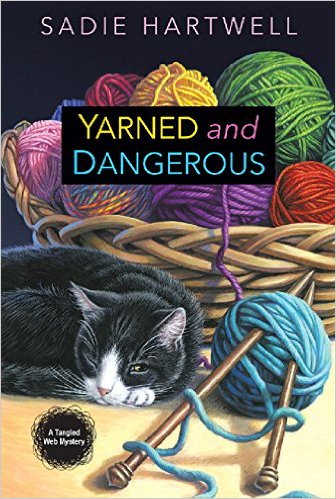
“Yarned and Dangerous” is the first in a new series about Dorset Falls and the group of ladies who make up the Charity Knitters Association.
Josie Blair has moved back to help out her uncle after he was injured in a car crash that took the life of his wife he had recently married, Cora. One of the important tasks she has to accomplish before leaving is to close down and sell the stock of Aunt Cora’s yarn store, Miss Marple Knits.
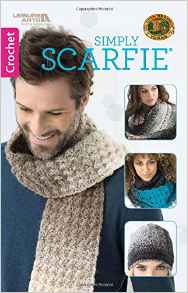 I was curious to try Scarfie yarn and when I found this book of fairly easy crochet patterns specifically designed to use it, I decided to give it a go. The patterns are all rated at least easy (with one noted as beginner.)